RESOURCESLabour laws, statutory requirements & workplace regulationsExplore the Compliance Library
For HR, finance and compliance teams in India

Statutory Compliance Services in India

Keep workforce obligations connected to the people, payroll data and records behind them. Datacore Technologies helps businesses organise statutory compliance through coordinated workflows, documentation and implementation support.

Payroll compliance | Contractor documentation | Filing calendars | Audit evidence
Clear responsibilitiesVisible deadlinesTraceable recordsConnected payroll inputsActionable exceptions
01 / CONNECTED COMPLIANCE

Connect compliance with everyday workforce operations

Returns depend on the employee and wage records prepared upstream. Employee changes, attendance inputs, wage components and contractor submissions all affect the compliance cycle. When these inputs sit in separate systems, teams spend valuable time resolving differences and locating evidence.

Datacore Technologies connects the compliance conversation with HR, payroll and vendor governance. We help define responsibilities, organise the required records and establish review steps around the obligations included in your engagement.

Bring PF and ESI requirements, payroll compliance, contractor records and statutory deadlines into a process your team can review and manage. Start with your business locations and workforce structure to define the support you need.

Where workforce compliance becomes difficult

01

Changing requirements need an operational response

A new notification can affect wage calculations, records, approvals or submission requirements. Teams need to identify the relevant change, assess its impact and update their working process before the next compliance cycle.

02

Each location brings its own obligations

Shops and Establishments requirements, professional tax and Labour Welfare Fund obligations can vary by jurisdiction. A shared national process still needs location-specific checks for applicability, registrations and due dates.

03

Payroll and contractor evidence must reconcile

A missing employee identifier, an unexplained wage difference or an incomplete contractor record can delay a review. Consistent data checks and documented follow-up make unresolved issues easier to identify and assign.

Understand the framework behind your obligations

India’s four Labour Codes took effect on 21 November 2025. The applicable duties must be read with the relevant central or state rules, notifications, schemes and transitional provisions. Requirements also depend on the establishment, workforce and activity involved.

Code on Wages 2019

Review wage definitions, minimum wages, payment requirements, bonus and equal remuneration provisions as applicable.

Code on Social Security 2020

Assess applicable social security obligations, including provident fund, employees’ state insurance, gratuity and maternity benefits.

Industrial Relations Code 2020

Check relevant industrial relations duties, including standing orders, dispute procedures and workforce changes.

Occupational Safety Health and Working Conditions Code 2020

Map relevant establishment, workplace and contract labour requirements to the appropriate rules and authority.

Legacy terms such as CLRA compliance and Factories Act compliance remain common in searches and historical records. Current requirements should be assessed under the applicable legal framework, including relevant savings and transition provisions.


02 / DATACORE

Statutory compliance support around your operating needs

Choose support around the obligations you need to manage, the locations involved and the work retained by your internal team. Software configuration, document preparation and operational services should be agreed as part of a defined scope.

01

Compliance applicability and obligation mapping

Begin with a practical view of your legal entities, workplaces and workforce categories. We help organise the information needed to identify applicable obligations and create a working register of activities, owners, due dates and supporting evidence.

  • Establishment and location information gathering
  • Obligation registers and compliance calendar setup
  • Responsibility mapping and document checklists
Build Your Compliance Scope
02

Payroll statutory compliance

Connect payroll inputs with the checks needed for applicable deductions, contributions and statutory outputs. Review employee data and wage information before preparing PF, ESI, professional tax, Labour Welfare Fund and salary TDS records within the agreed scope.

  • Payroll input review and exception follow-up
  • Applicable contribution and deduction reconciliation
  • Return preparation support and payment evidence tracking
Build Your Compliance Scope
03

Labour law and establishment compliance

Organise employment records, registrations and renewal activities around the requirements relevant to each workplace. Scope can include Shops and Establishments documentation, statutory registers and employment-related records for offices, factories and other covered establishments.

  • Registration and renewal document coordination
  • Employment, wage, attendance and leave record organisation
  • Location-specific compliance review checklists
Build Your Compliance Scope
04

Contractor and vendor compliance coordination

Give contractor documentation a consistent review process. We help organise onboarding records, applicable registration and licence evidence, wage documentation and social security contribution records so your team can identify gaps and follow up with the responsible vendor.

  • Contractor document collection and expiry tracking
  • Workforce and supporting record checks within scope
  • Findings, assigned actions and closure evidence
Build Your Compliance Scope
05

Compliance reviews and inspection preparation

Prepare for internal reviews and authority requests with records that can be located and explained. Review support can include document indexing, evidence checks, an issues register and coordination of corrective actions agreed with your team.

  • Document review and evidence gap identification
  • Inspection information packs and query tracking
  • Corrective action ownership and follow-up
Build Your Compliance Scope
06

Compliance workflow configuration and reporting

Use Datacore’s platform capabilities to organise compliance work alongside HR, payroll and vendor information. Configure relevant calendars, document records, access permissions and reporting views around the modules included in your implementation.

  • Deadline reminders and document expiry workflows
  • Role-based access and recorded activity histories
  • Reports on pending activities and unresolved findings
Build Your Compliance Scope

Principal employer responsibilities require specific assessment. A contractor’s declaration or uploaded document should not be treated as proof that every underlying obligation has been fulfilled.

The engagement should identify who prepares, approves and submits each return, and who authorises and makes statutory payments. Filing preparation and successful payment are separate steps, each requiring its own evidence.

03 / OUR PROCESS

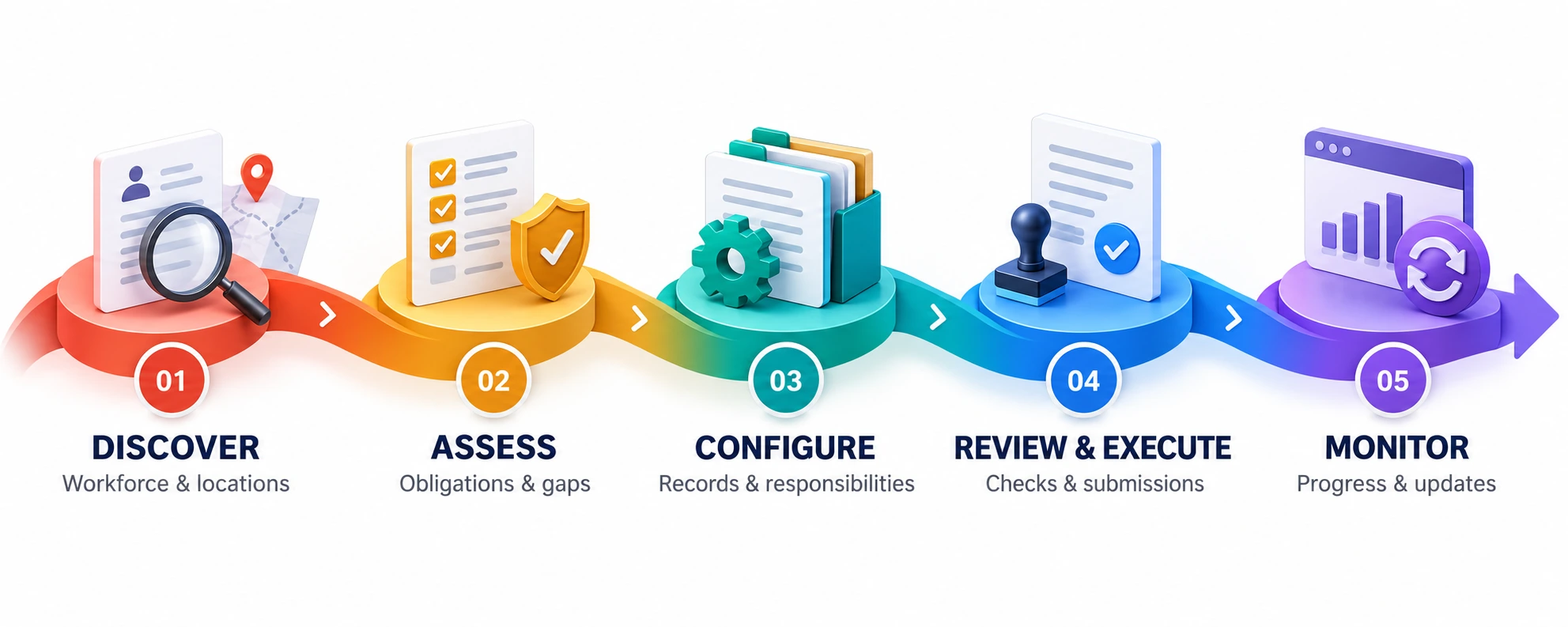
How a compliance engagement takes shape

Discuss Your Current Compliance Process
A colorful connected journey through five compliance stages: Discover, Assess, Configure, Review and execute, and Monitor.
Discover: workforce and locations. Assess: obligations and gaps. Configure: records and responsibilities. Review and execute: checks and submissions. Monitor: progress and updates.

Select a stage to explore the process

01 / Discover

Understand your workforce and locations

Gather entity details, workplace information, employee categories, payroll arrangements and contractor relationships. Confirm the activities your team wants to retain and the support required from Datacore Technologies.

COMPLIANCE VISIBILITY

Make compliance status easier to review

Reporting should help your team distinguish work that is due, awaiting information, under review or completed with evidence. Useful indicators include:

  • Activities due in the next reporting period
  • Returns with both submission and payment evidence, where required
  • Documents approaching expiry and renewals awaiting action
  • Open contractor findings and overdue corrective actions
  • Records awaiting reconciliation or management approval
04 / DATACORE

What a structured compliance process supports

Earlier attention to deadlines

A maintained calendar makes upcoming work visible and gives teams a basis for scheduling data collection, review and approvals.

Less repeated document chasing

An organised record structure helps reviewers find the latest document and identify missing evidence without restarting the same email chain.

Better preparation for reviews

Linking obligations with supporting records helps teams explain completed work and respond to specific audit or inspection questions.

Clearer responsibility across locations

Shared reporting with location-level ownership makes it easier to see which establishment needs information, approval or corrective action.

More focused contractor follow-up

Documented findings and assigned actions give vendor managers a practical basis for escalation and closure checks.

How statutory and regulatory compliance relate

The two terms overlap. Statutory compliance concerns duties arising from legislation. Regulatory compliance includes applicable rules, directions and conditions administered by regulators, many of which also have a statutory basis.

AspectWorkforce statutory complianceSector regulatory compliance
Typical focusEmployment, wages, social security and workplace records.Requirements tied to a regulated business activity.
ExamplesApplicable PF, ESI, wage, gratuity and establishment duties.For example, RBI requirements for regulated financial entities or FSSAI conditions for food businesses.
ApplicabilityDepends on the entity, workforce, establishment and jurisdiction.Depends on the sector, activity, licence and regulator.
Page scopeWorkforce compliance workflows and agreed operational support.Specialist sector advice must be scoped separately.

Outsourcing support does not remove an employer’s statutory responsibilities. Clear approvals and reliable source information remain essential.

05 / WHY DATACORE

Why consider Datacore Technologies

CONNECTED WORKFLOW

From workforce records to management review

Reliable inputs and documented approvals support each stage of the compliance cycle.

  1. 01

    Employee and attendance records

  2. 02

    Payroll review

  3. 03

    Statutory output preparation

  4. 04

    Authorised submission and payment

  5. 05

    Evidence and management review

CONTRACTOR WORKFLOW
  1. Contractor records
  2. Vendor review and corrective actions
  3. Evidence and management review
06 / DATACORE

Compliance priorities across industries

Workforce obligations vary with the activity, establishment and people involved. Use your industry context to identify the records and reviews that need attention.

Information technology and services

Coordinate office establishment records, employee changes and payroll compliance across distributed teams.

Global capability centres and captive operations

Align India workforce records and local compliance activities with internal approvals and group reporting requirements.

ITES and business process management

Review shift, attendance and wage records alongside applicable employment conditions and payroll deductions.

Logistics and warehousing

Map obligations by depot or warehouse and organise contractor workforce evidence for periodic review.

Manufacturing

Bring establishment documentation, workforce records and contractor reviews into a consistent review schedule.

Retail and multi-location businesses

Track outlet-level registrations, staff movement and state-specific payroll obligations as locations change.

View more industries

Healthcare

Organise employment, shift and outsourced workforce records alongside the applicable workplace requirements.

Biotechnology and pharmaceuticals

Coordinate workforce compliance records across offices, laboratories and production sites with different operating arrangements.

Engineering and research operations

Review employee and contractor documentation across project offices, research facilities and technical locations.

Aerospace

Map workforce record requirements across engineering offices and production facilities, including relevant contractor arrangements.

Shipbuilding

Coordinate employment and contractor documentation by yard, project and applicable workplace jurisdiction.

Electric vehicles and battery production

Review workforce categories, shift records and establishment requirements as production and supplier operations develop.

Semiconductors

Organise compliance activities across design centres and manufacturing sites with distinct workforce arrangements.

Automotive

Track payroll and contractor evidence across plants, engineering functions and other covered locations.

Oil and gas

Assess workforce documentation and contractor responsibilities for the relevant office, operational or project setting.

Renewable energy

Review employment and vendor records across development offices, installation projects and operating sites.

Agritech

Identify the workforce requirements relevant to technology offices, research locations and field activities.

Small businesses and growing teams

Establish clear payroll records and review applicable obligations as headcount, locations and working arrangements change.

Plan compliance around each business location

Opening a new office or adding employees in another state can change the compliance work your team needs to manage. Discuss your operating locations with Datacore Technologies to establish the supported jurisdictions, relevant records and delivery scope.

Check Support for Your Locations
07 / YOUR QUESTIONS

Statutory compliance questions answered

Discuss Your Compliance Needs

What does statutory compliance mean for an employer in India?

It means meeting the legal obligations that apply to the employer and its workplaces. Depending on applicability, these can include wages, social security, establishment registrations, employment records and statutory submissions. The correct obligation list depends on the business activity, locations and workforce arrangements.

What can Datacore Technologies help our team manage?

Datacore’s offering brings together statutory compliance workflows, payroll information and vendor audit capabilities. Discuss the registrations, records, returns and review activities you need so that the proposal identifies the available modules and services, supported locations and responsibilities assigned to each party.

Which information is needed to assess our obligations?

Start with legal entity details, workplace addresses, business activities, workforce numbers and categories, wage information and contractor arrangements. Existing registrations and previous submission records help establish the baseline. Thresholds and exemptions should be checked against the rules relevant to each establishment.

How do the four Labour Codes affect compliance planning?

The four Labour Codes took effect on 21 November 2025. Employers need to assess the provisions, rules, schemes, notifications and transitional arrangements applicable to their operations. References to older legislation in existing records should be reviewed rather than assumed to describe the current requirement.

Are compliance requirements the same in every Indian state?

No. State-specific requirements can affect Shops and Establishments compliance, professional tax, Labour Welfare Fund contributions and other activities. Their applicability and timelines differ. A location-level obligation register helps teams identify which requirements and review dates belong to each establishment.

What is included in PF and ESI compliance support?

The agreed scope may cover reviewing employee information, checking applicable wage and contribution data, preparing statutory outputs and organising submission and payment evidence. EPF is administered by EPFO and ESI by ESIC. Coverage, calculations and the current filing workflow should be assessed for the relevant establishment and employees.

How is contractor compliance reviewed?

A review can examine relevant registrations, licences, workforce details, wage records and contribution evidence against the agreed checklist. Gaps should have an assigned owner and documented follow-up. Principal employer obligations need separate attention; outsourcing work to a contractor does not automatically remove the business’s responsibilities.

Which records should we keep for a compliance review?

Relevant records can include registrations, licences, statutory registers, appointment and employment records, attendance and wage information, returns, challans, payment evidence, acknowledgements and contractor documents. Retention periods and permitted formats depend on the applicable requirement. Access should be limited to authorised people.

Can Datacore help with audit or inspection preparation?

Discuss document organisation, evidence checks and query tracking as part of your required service scope. Confirm which activities Datacore can provide and which need an authorised signatory or specialist adviser. A complete document pack supports preparation but does not determine an authority’s findings.

Does using a compliance partner transfer our legal responsibility?

No. A service provider can support agreed activities, but the employer retains the duties imposed on it by law. The engagement should clearly allocate data preparation, review, approval, submission and payment tasks, together with the authorisations and escalation steps needed to complete them.

What can happen if a statutory obligation is missed?

Consequences depend on the law and the circumstances. They may include interest, damages, penalties, notices, recovery proceedings or other action. If a gap is identified, assess the current position, preserve relevant records and agree appropriate corrective action with qualified support where needed.

How do we start a statutory compliance discussion with Datacore?

Share your business locations, approximate workforce size, payroll arrangements and main concerns through the enquiry form. Datacore Technologies can then discuss the modules and services relevant to your requirement and help define the proposed scope. Keep employee-level personal records out of an initial public enquiry.

08 / LET’S TALK

Build a clearer plan for workforce compliance

Tell us where your business operates and which compliance activities need attention. Datacore Technologies can help you explore a practical combination of workflows, software and support for the requirements you identify.

Tell us about your compliance requirement

Share a few business details so we can understand your requirement and direct your enquiry to the relevant team.

Please describe your business need without including employee identity numbers, payslips or other personal employee records. Fields marked with an asterisk are required.